We want to dedicate this month's experience to a key historical figure for understanding and getting to know our medieval fortified landscape, Al-Azraq. The announcement comes this month to reveal that the year we will soon be entering, 2026, has been declared the Year of Al-Azraq by the regions of El Comptat, Alcoy, the Vall d'Albaida, the Marina Baixa and the Marina Alta. In 2026, we will commemorate the anniversary of his death, and our towns' programmes will be filled with cultural activities such as recitals, concerts, theatre performances, guided walks and conferences about this figure and pivotal moment in the history of the Marina Alta.
The main objective of this experience is to discover the historical and natural richness of the inland area of the region. We will do sports while enjoying beautiful views, good food, and stays in charming country houses or hotels. As for the historical part, we will learn about the Muslim chieftain Al-Azraq. From MACMA, we have proposed a series of routes to discover points of historical interest related to this character, namely the castles that served as his refuge during uprisings and the Castle of Alcalá, where he resided. Initially, we have planned it to be done over six consecutive days, starting on a Friday, but each person can adapt it to their own needs and abilities.

A BIT OF HISTORY. We know where we come from to decide where we are going.
Al-Azraq is famous for his enmity towards James I during the Christian conquest in the 13th century. He was born in the Vall d'Alcalà and came to occupy an extensive territory which, in part, corresponds to part of the present-day Marina Alta.
He led three uprisings against the Christians. The first took place in 1247 when he refused to hand over the castles of Gallinera, Serra, Penàguila and Pego to the king. When the revolt was suppressed, James I decreed his expulsion, but in 1258 he returned to organise what some authors have called “the Valencian rebellion”. In just one week he captured 16 castles from the king, defeated an army of 3,000 Christian crusaders and prepared an ambush at the castle of Rugat to assassinate the monarch.
This enterprise failed and Al-Azraq was sent into exile, under the protection of the King of Castile. The third revolt took place in April 1276, with the assault on the city of Alcoy, where he lost his life. He proved to be a shrewd, mysterious, ambitious and self-assured leader, a figure quickly mythologised for the symbolism of his leadership; even Peter IV, in his chronicle, describes him as the great “captain” to whom all the Saracens pledged their loyalty. The Marina Alta is a region rich in historical heritage from the Muslim era.
 Bust of Al-Araq.
Tips for the routes
- Bring comfortable footwear and water.
- Respect nature and the architectural remains.
- For more information, please consult the tourist information offices.
SUGGESTED ITINERARIES. Step by step, we make our way.
Alcalá de la Jovada: Castle of Alcalá or of Benissili
Stage 1: Alcalá de la Jovada - Tossal de la Creu - Castle of Alcalá or of Benissili - El Xarpolar - the Moorish ghost village of La Roca - Alcalá de la Jovada
The first stage of this route takes us through the Vall d'Alcalà, the birthplace of Al-Azraq. We recommend doing the route to the castle in the morning, when it's not so hot, as it was the leader's usual residence.
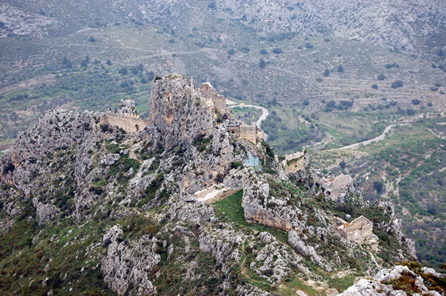 View of the Alcalà Castle.
The origin of the castle of Alcalà or Benissili dates back to the 11th century. Its first appearance in official documents is in 1245. It was on this date that the Treaty of Pouet was signed: the lord of the castle, al-Azraq, ceded ownership of the castles of Pop and Tàrbena to the conqueror and was permitted to retain those of Alcalà and Perputxent, undertaking to hand over Gallinera, Margarida, Xeroles and Castells within the following three years.
We suggest this circular route to climb the castle. It is of moderate difficulty and will take us the whole morning. It also includes a visit to the Iberian settlement of Xarpolar, where you can see the remains of a double walled enclosure that surrounds and defends the settlement. You can also make out the outlines of some dwellings and other structures of uncertain purpose, and the hamlet of La Roca. Ten families lived in this farmstead in 1563. It was depopulated following the expulsion of the Moriscos in 1609, but was repopulated by Old Christians from 1611. The visible remains belong to a single architectural complex, made up of about five contiguous units, perfectly aligned from east to west, with a common party wall, and with the façades facing the track. We can observe remains of the walls that surrounded the settlement.
At midday we recommend having lunch at one of the restaurants in Alcalá de la Jovada and sampling the minxos, corn tortillas typical of the Alcalá Valley.
After lunch, it would be interesting to take a stroll around the village, where you can see the two fountains dedicated to Al-Azraq, the church and the Maiden's Tower. The two fountains are as follows:
- Around the Church of the Immaculate Conception, we find a practically natural fountain, built with stone beside the very rock of the mountain. The fountain has a stone basin and, at the top, a solid wooden board. In front of the fountain, there is a bust of Al-Azraq on which we can read: ‘Al-Azraq, vizier and Muslim lord of the places of Alcala until 1276 when he left our land for ever, never to return. 708 years ago. The Valley of Alcala. 1984’. It is surrounded by vegetation.
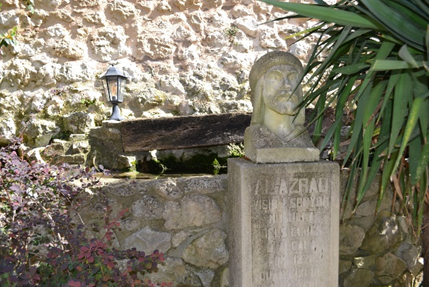 Fountain of the church.
- We find the other, modern fountain in Al-Azraq Square, opposite the town hall. It is a stone fountain built into the wall that runs across the square. There is a bronze head of Al-Azraq, from whose mouth water flows into a semicircular basin.
 Fountain in Al-Azraq square.
To finish the day, you can spend the night in Alcalá or head towards Castell de Castells, where we will begin the second stage.
Castell de Castells: the Castle of La Serrella
Stage 2: Castell de Castells - Castle of La Serrella - Ethnological Museum
The second day begins in Castell de Castells, directly from the Castellet recreational area, with the ascent to the Castle of la Serrella. It is not very difficult and you can easily enjoy marvellous views of the mountains of our region and the Marina Baixa.
The first documentary record of the Castle of la Serrella is found in the Pouet Pact of 1245, between King James I and Al-Azraq. The fortification was ceded to the Muslim leader for his use for three years. It was later taken by King James I in 1250 and was abandoned shortly after the Christian conquest. The castle stands at an altitude of 1,050 metres on a rocky, difficult-to-access outcrop called the Penya del Castellet, in the municipality of Castell de Castells, controlling the junction of the Castells and Guadalest valleys. It is one of the castles most frequently mentioned in the Pact of the Pouet, signed at the castle of Alcalá.
The remains that have survived to the present day are scarce, including some half-ruined stretches of wall, a cistern and the lower parts of some towers, the largest of which, crowning the mountain, is particularly notable.
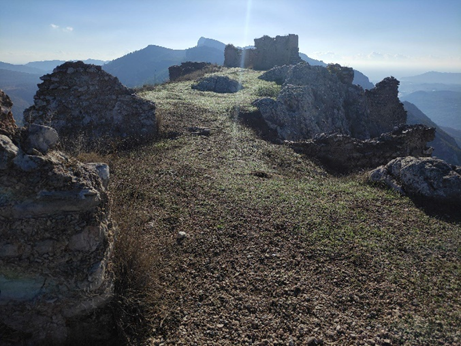 Serrella Castle.
On returning to Castell de Castells, you can refuel, and now that the cold has arrived, we recommend trying the local putxero to warm you up. To round off the day, you can stroll through the village's historic centre and visit the Petracos Museum of Macro-schematic Art and Ethnology, an ethnographic collection dedicated to understanding the arrival of the Neolithic on the Iberian Peninsula and its characteristics, brings together objects related to the traditional way of life and the rural world of the inland Alicante mountains. Please note that the museum is only open in the afternoons on Fridays and Saturdays.
The Laguar Valley: Castle of the Atzavares
Stage 3: Campell - Castle of the Atzavares - Fontilles Wall - Fleix
On the third day, you should head to Campell in the Laguar Valley. Here you will do an easier route, which you can comfortably complete in two hours. You will go to the Castle of the Atzavares. It is located at the entrance to the Laguar Valley, on a topographical height of just over 350 metres. Situated on the summit, on vertical faces facing north, you can see the remains of walls made of hard-consistency rammed earth. These are rectilinear alignments that define two rectangular enclosures, partially excavated into the rock. The exact date of its construction is unknown, but pottery remains dating from the 11th century have been found. The castle was occupied by Al-Azraq during the revolt of 1276.
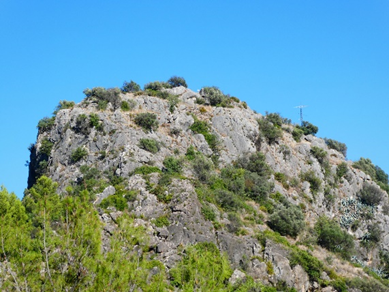 Atzavares Castle.
From there you can go via the Muralla de Fontilles or visit the Sanatorium, another point of historical interest, and we recommend returning to Laguar for lunch at one of the restaurants or popping into a butcher's to sample the local cured meats. In the afternoon, you can take a stroll through the three villages or drive up to Collao, where you can enjoy the views and the vegetation. We recommend staying overnight in the Laguar Valley.
The Gallinera Valley: Benirrama Castle
Stage 4: Benirrama - Font de la Mata - Benirrama Castle
The next day, you will need to travel to the Gallinera Valley, specifically to the first settlement, Benirrama, where you will do a section of the route to the castle, which can take approximately three hours. You will need to park in the village and from there head for the Benirrama Fountain of the Mata. On the way, we will pass by the deserted hamlet of Benimarsoc and its fountain. As we approach the Fountain of the Mata, we will climb the path that leads us up to Benirrama Castle.
The castle's historical function was to guard and defend the entrance to the valley from the sea. The first document in which the castle of Ghallinayra appears dates from 1245, in the Pact of the Pouet. In 1247, during the first uprising, the Saracens captured this castle. On 1 June 1258, the castle was recaptured by King James I who, from 1261, granted it to various individuals to settle the debts he owed them. On 22 June 1322, James II granted the castle to his fourth son, Prince Peter of Aragon, Count of Ribagorza. This donation put an end to the royal status of the Gallinera district, which became a feudal lordship.
 Benirrama Castle.
On your way back, you can head off to see the Benirrama rock art shelter or return to the car. In the Gallinera Valley there are several restaurants where you can sample the local cuisine, such as cracked wheat or baked rice. Wild boar, cooked with local herbs, is also typical.
In the afternoon, you can visit the other seven villages that make up the valley. Benialí, Benissivà, Benitaia, La Carroja, Alpatró, Llombai and Benissili are quiet villages surrounded by greenery where you can visit the various wash-houses and churches. To finish the day, you can spend the night in a country house in the Gallinera Valley or head towards Atzúbia.
Atzúbia: Castell de Forna
Stage 5: Atzúbia - Tossal del Llop - Cova del Canelobre - Castell de Forna - Forna
The next stage begins at Atzúbia and you will walk to Forna. Along the cemetery path, you will pass the Tossal del Llop recreational area and the Cova del Canelobre; to visit the cave you must contact the town hall. Afterwards, you will continue towards Forna Castle, following a section of the Alba Path. To climb the castle, you will need to set off before you reach Forna. Currently, the castle can only be viewed from the outside as it is undergoing internal rehabilitation and restoration.
Forna Castle is a fortress located in the municipality of Forna. It was in the possession of Al-Azraq until it was conquered by James I, who ceded it in 1258 to Arnau de Romaní. The first Christian mention of Forna comes from James I, who founded the Barony of Forna to entrust its administration to the captain of archers, Bernat de Guillem (who fought against al-Azraq's revolts), in 1282. The castle is organised around a central courtyard and is protected by four towers at the ends.
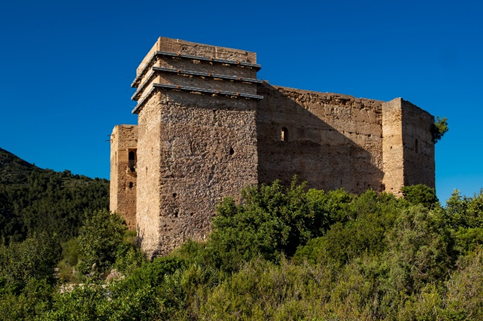 Forna Castle.
From the castle you can then descend to Forna, where you can visit the wash-house and the underground spring. We recommend having lunch there before returning to Atzúbia. To return and finish the day's walk, you can either take the same path back or follow the Carritxar route to Atzúbia. This route offers a wonderful panoramic view of the Pego-Oliva Marshes Natural Park, the eastern slope of the Mostalla and Segària mountain range, and you can even spot Montgó in the distance.
Pego: Castle of Ambra
Stage 6: Pego - Castle of Ambra - Font de l'Asbeurà - Rupais - Baladrar
This final route is longer and more difficult. We suggest going to Ambra Castle via natural springs and places with panoramic views of Pego. We recommend following the spring trail, which will allow us to discover Pego's three springs: the Asbeurà spring, the Rupais spring and the Baladrar spring, and also to climb the castle, where we will have to deviate a few metres from the route.
The Castle of Ambra, which dates from the early 13th century, is a very late construction. In the face of the advance of James I's troops, the rural communities organised themselves to build a refuge-castle where they could establish temporary accommodation while awaiting the arrival of the Christian army. Inside the keep there are a total of 20 dwellings. The castle did not take an active part in the conquest, but it did play an important role in the subsequent Moorish revolts led by Al-Azraq. After being in Saracen hands for three years, from 1276 the castle began to lose its military importance. It eventually lost this importance completely when the new town of Pego began to be established from 1280.
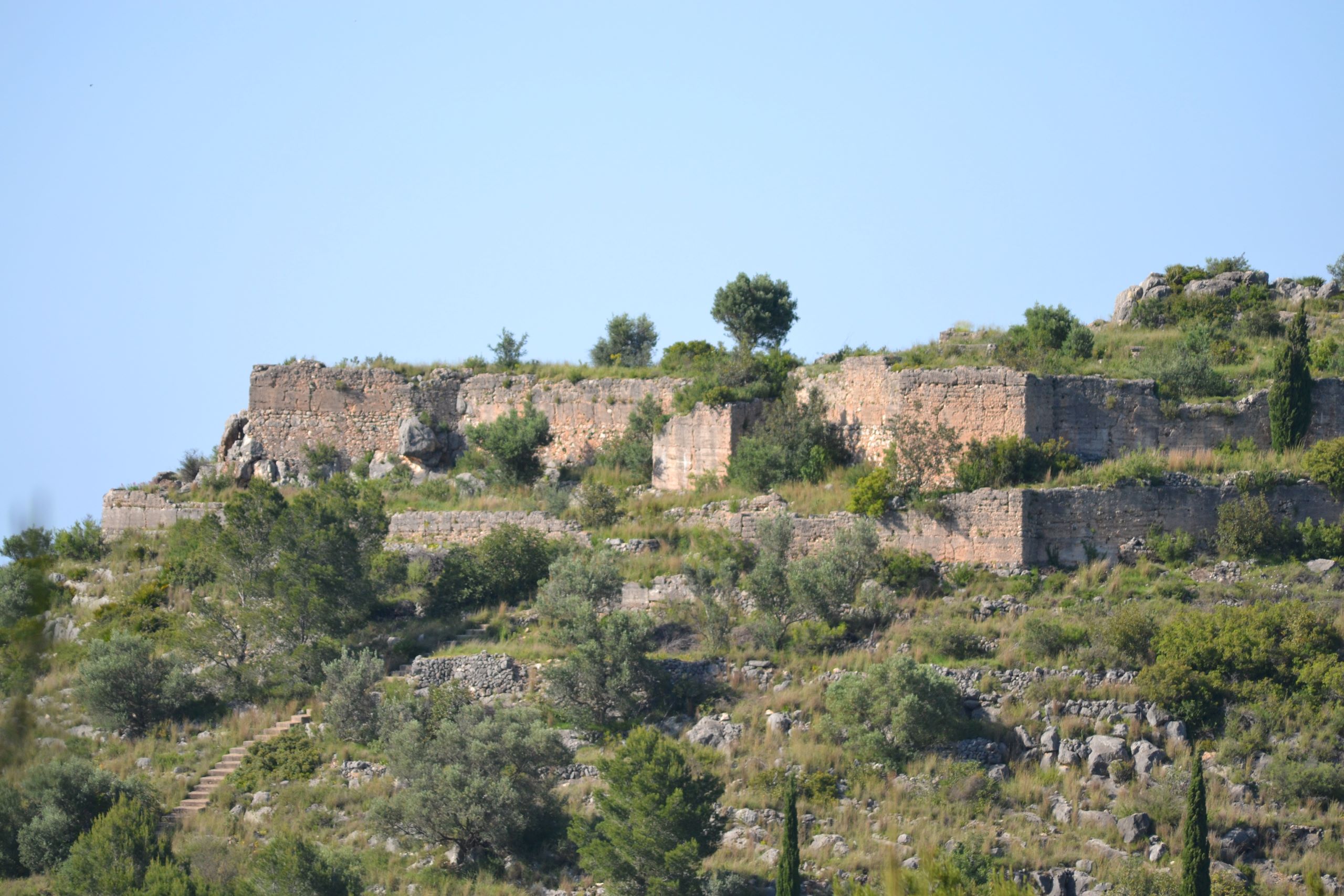 Ambra Castle.
After visiting the castle, we will return to the spring trail. First, we will visit the Asbeurà spring, continue to the Rupais spring and finally the Baladrar spring. The latter is located near the road to Sagra. Once we have visited them, we will descend the agricultural path that leads to Pego, passing the abandoned hermitage of Sant Sebastià, surrounded by orange groves. Finally, you will arrive at the village of Pego.
*This experience is designed to be done in six stages, corresponding to six different days. We suggest some routes, but each person can adapt the experience to their abilities, physical stamina and interests. If you would like more information or details on places to visit in each village, you can visit the Descobrim la Marina Alta website and adapt the experience to your own tastes with your rucksack. You can also find out about all the activities and projects for the year Al-Azraq at El Blau 750.

AND MORE. On the table and in bed at the first cry.
 Where to buy |  where to eat |
 where to sleep |  Activities and others |
Translation by DeepL.