We want to dedicate this month's experience to the ancient hydraulic architecture of La Rectoria and its natural surroundings. The proposed route offers us the opportunity to discover the natural and cultural heritage formed by the ensemble of architectural elements linked to the use of water as a resource that provides wealth and security, revealing a specific and functional configuration of the agricultural landscape and housing a unique hydraulic heritage of the village and La Rectoria as a whole. Primarily, we will focus on the watermills, although we will also be able to see wells, fountains and washhouses.
The main objective of this experience is to learn about the workings of the old watermills and their surroundings, while also getting some exercise and enjoying the beautiful views and the local cuisine. To this end, MACMA is offering you a route through La Rectoria, known as the Water Architecture Route. It is a low-difficulty route that can be done in a morning, but we have divided it into two days to be able to visit Sagra and El Ràfol more leisurely. However, everyone can adapt it to their own needs and interests.
A LITTLE HISTORY. We know where we come from to decide where we are going.
Water is the element that made the birth of agriculture and the transition from nomadism to sedentary life possible during the prehistoric era. Thanks to this, humanity ceased to be exclusively hunter-gatherer and became farmers and herders, thereby expanding the variety of foods consumed. But at a certain point, humans realised that wheat could be used to make other foods, although it first had to be ground into flour. For this purpose, they used hand-operated mortars, which were later replaced by animal power. However, to increase production, wind and water power were eventually introduced through windmills and watermills. In this experience, we will focus on watermills.
The great expansion of these mills took place in the 11th and 12th centuries, especially thanks to the Arabs, at a time of population growth when it was essential to increase production to supply the entire population. The mills operated mainly in the autumn, when the temperature was suitable to prevent the flour from fermenting, and because the rains of this season increased the water flow and, as irrigation of the orchards was not required, water was fully available for the mills.
Watermills had great social and economic importance until the 19th century, when they began to lose significance with the advent of industrialisation and other means of energy production and use. Unfortunately, many mills have disappeared today, and those that still survive are generally in a precarious state.
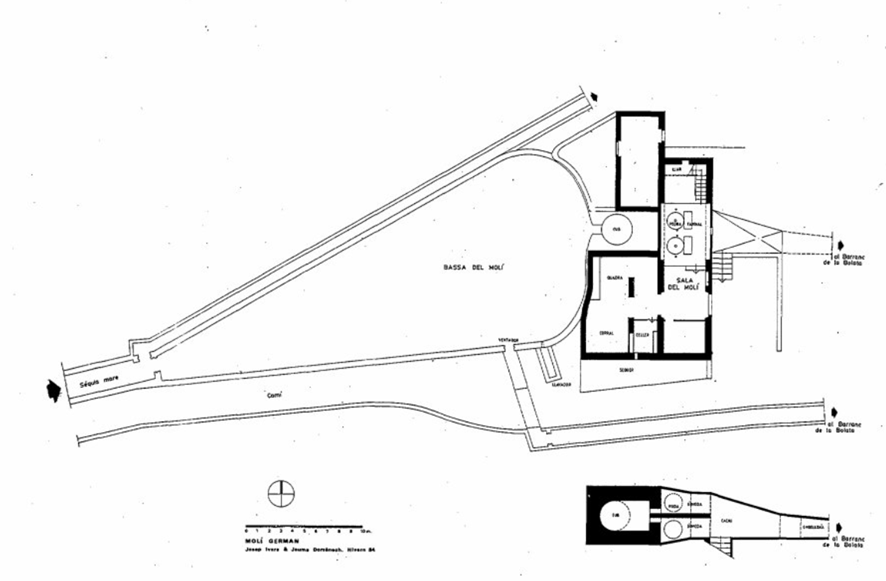 Plan of a watermill.
For the operation of this type of mill, water was delivered via a canal from another mill or from a weir and entered the accumulation pond. This pond had a spillway, which allowed excess water to be discharged if necessary. From the pond, the water passed to a cistern which held it back, releasing it slowly through a small opening called ‘sagetilla’, until it reached the waterwheel. This wheel was connected to an axle which powered all the mill's mechanisms. Finally, the water exited through some arches called ‘cacaus’ and, via a canal, it was diverted to another mill or used for irrigation.
To grind the grain, it was poured into the hopper, located above the axle. This had a capacity for approximately 80 kg of grain. From here, the wheat passed to the millstone, which ground the grain using its grooves. This turned it into flour which, through the flour chute, finally reached the flour bin.
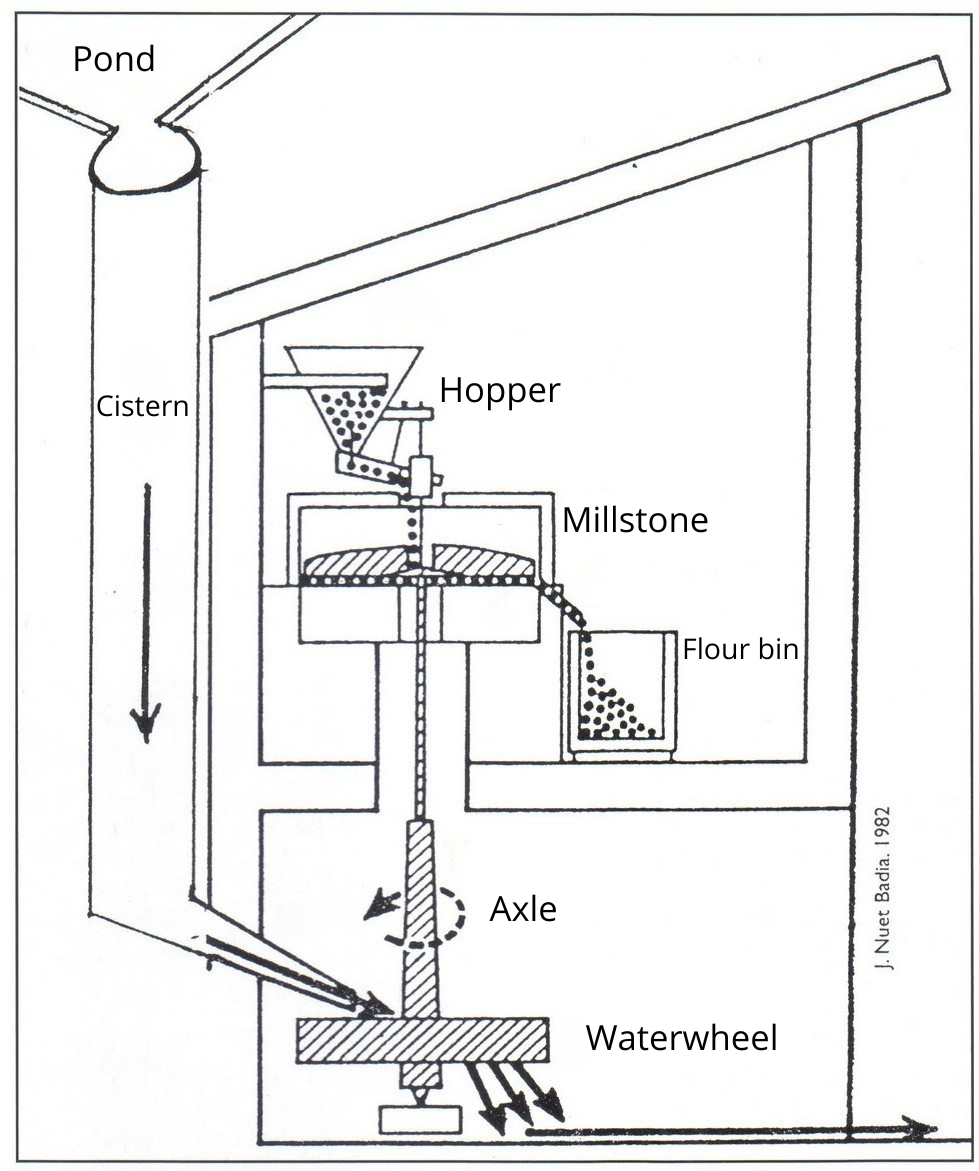 Parts of the watermill.
Tips for the routes
- Bring comfortable footwear and water.
- Respect nature and architectural remains.
- For more information, consult the tourist information offices.
SUGGESTED ITINERARIES. Step by step, we make our way.
From El Ràfol d'Almúnia to Sagra
Stage 1: Companyia Well - German Mill - La Bolata - Torre Máquina Well - Putxó Well - Senent Well - Sagra
The first stage of this route is the journey from El Ràfol d'Almúnia to Sagra, during which we will visit the aforementioned sites. We can drive to El Ràfol and park in a public car park on the outskirts of the village, near the route's starting point.
We will take the road towards the cemetery to get to the Companyia Well. We will find it straight away on the left-hand side of the road. This well was built in 1911 to extract water from the Cava del Ràfol, which is a gallery located in the Serra de Segària with water diverted from the River Girona. This water was used to irrigate all the surrounding crops. Currently, the variable flow has decreased considerably, so that in 1911 it flowed at 12,000 litres per minute, whereas now it is only 3,000 litres per minute.
 Companyia well.
We will continue walking and take a slight detour from the main road to find the German Mill. This mill draws its water from another, the Lower Mill, which we will visit later. It was once the property of the Marquess of Dues Aigües and, from the late nineteenth century, of Blas Cañamás. The tenant millers for three generations were the Furió del Ràfol family, beginning with German Furió, until 1942. It is a late-17th-century mill that was sold in 1989 to become a family home.
 German mill.
Afterwards, we will pass through the ravine of La Bolata. La Bolata is a spring situated between Tormos and Sagra, whose flow is formed mainly by the Sierra del Migdia and the Recingles. The water flows from west to east and is characterised by an irregular flow. It is currently dry most of the time. According to Madoz, the water from Bolata was used to irrigate the neighbours' lands and powered two watermills.
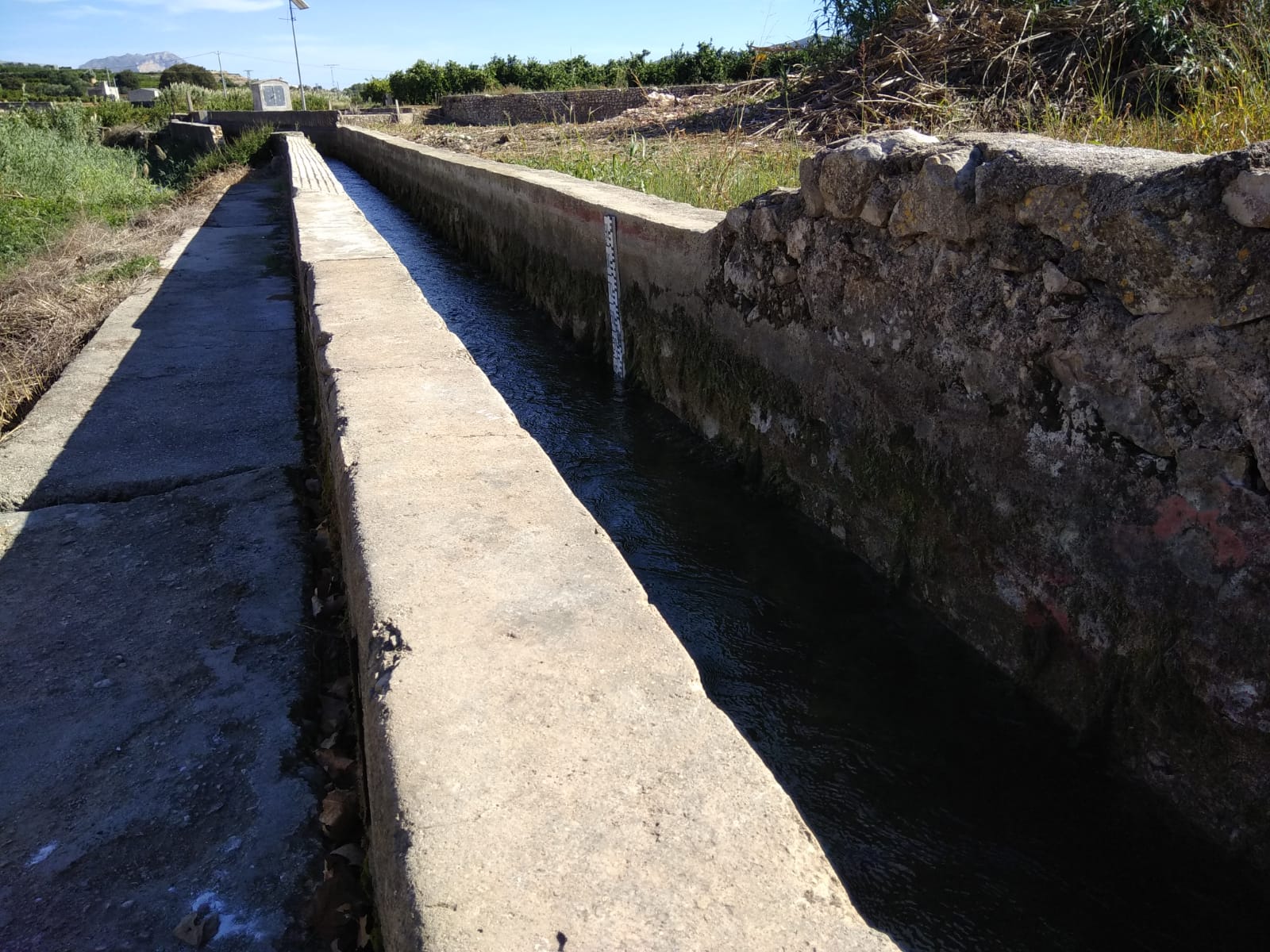 La Bolata.
Next, we'll take a detour to reach the Torre Màquina well, an interesting structure with a tall tower that can be seen from afar. We'll find the building in the middle of orange groves. Then we'll return to the main path to pass by the Putxó and Senent wells, following the Olivars route and, finally, arrive at Sagra.
 Torre Màquina well.
Upon arriving in Sagra, we can sample the rice stew with greens at a bar to warm up. We can also visit the Church of Saint Sebastian the Martyr, which was built in the 16th century on the ruins of a mosque. Also of interest is the Plaza de la Font. At the beginning of the 20th century, the civil authorities took advantage of the strategic location of the springhead of the Basseta fountain and built this square on the right-hand side of the road adjacent to the spring. Afterwards, we will rest for the next day's route.
From Sagra to Ràfol d'Almúnia
Stage 2: Sagra – Font dels Mortits – Pou Sant Sebastià – Molí del mig – Molí de Baix – Llavador del Ràfol – El Ràfol d'Almúnia
From Sagra, we will take the Carrer Francesc Ferrer Pastor for a walk to the Font dels Mortits. Around the village of Sagra, numerous springs of clean, crystal-clear water gush forth, among them the Dalt del Mortit spring, located in the area of the same name which, beneath a large rock, flows with considerable intensity for most of the year. Afterwards, we would return to Sagra to head for the Saint Sebastian well, a structure from 1954, via the Horts Street.
 Saint Sebastian well.
We will take a slight detour from the main road to visit the Middle Mill. It received water from the Upper Mill via a canal that is still preserved in perfect condition. It then sent it on to the Lower Mill. It was owned by the Morands of Dénia until the 1930s, when it ceased to operate. The miller was Francisco Ballester. It was bought by Joaquim Ballester of Ràfol and eventually became a dwelling.
 Middel watermill.
Afterwards we will continue on to the Baix mill, which received water from the latter and subsequently sent it on to the German mill, the first one we visited. It belonged to the Marquess of Dues Aigües and later to the Morands as well. Subsequently, it came into the ownership of the Nadal family of Ràfol. This mill has also ended up being converted into a private residence.
 Baix Mill.
Returning to Ràfol, we can visit the old public washhouse to finish the walk. Later, we can take the opportunity to have lunch and spend the afternoon in the village. It is recommended to try the meat paella made with local ingredients. It would also be interesting to stroll along Major Street, where there are stately homes. Finally, we can take the opportunity to see the pecked coat of arms of the Second Germanía. Marina Alta was one of the key centres of the new Germanía. Its most representative leader, Francesc Garcia, a native of Ràfol d'Almúnia, emerged from here. The starting point for the events of 1693 was, without a doubt, the problems of repopulation after the expulsion of the Moriscos and the harshness of the feudal system. The well-to-do peasant class aimed to eliminate the feudal lords as intermediaries between themselves and the Crown. In this case, Ràfol d'Almúnia paid Marquess Joan d'Almúnia a quarter of all agricultural produce, in addition to a quantity for the houses. During the Second Germanía, the coat of arms of this family was pecked by the peasants in protest against the lords.
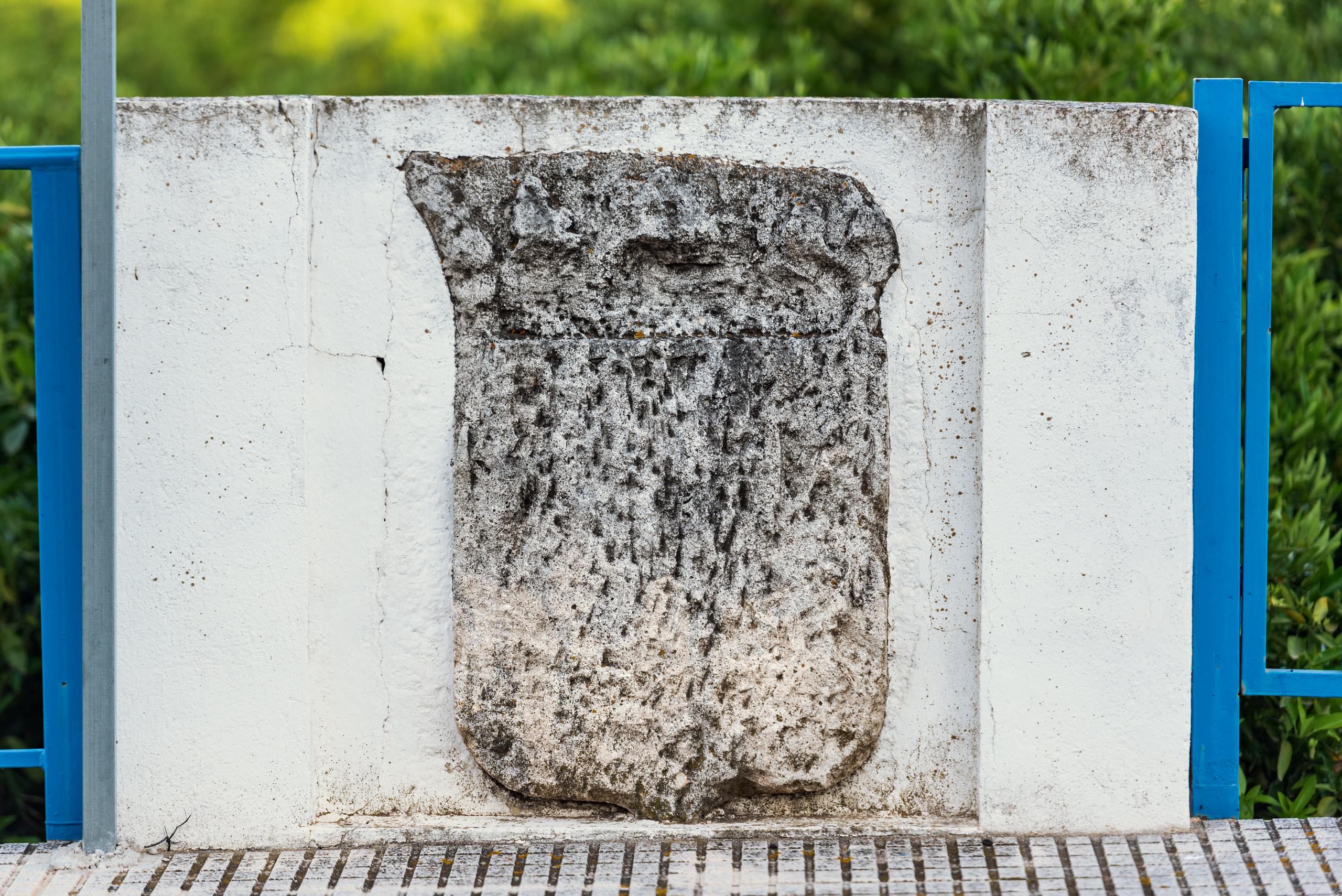 The coat of arms.
This would be the end of our suggested route, which can be adapted depending on each person's tastes or preferences. If you want to extend the route, you can visit the “Rectory's Water Architecture Route” on Wikiloc.
*This experience is designed to be done in two stages, which correspond to two different days. We suggest some routes, but each person can adapt the experience to their abilities, physical stamina and interests. If you would like more information or more places to visit in each village, you can visit the Descobrim la Marina Alta website and adapt the experience to your own tastes with your rucksack.
AND MORE. On the table and in bed at the first cry.
 Where to buy |  where to eat |
 where to sleep |  Activities and others |
Translation by DeepL.